
If you told someone ten years ago that a single product could generate over $1.3 million in revenue on Amazon FBA, they probably would have laughed. Today, that’s not only possible, it’s happening for regular people with no warehouse, no employees, and no prior business experience. The opportunity is real, it’s growing, and the barrier to entry is lower than most people think. Whether you’re looking to escape a nine-to-five, build a side income, or create a business that funds your lifestyle, Amazon FBA gives you one of the most accessible paths to get there.
The process itself comes down to six clear steps: setting up a seller account, finding a product with real demand, partnering with a manufacturer, understanding fulfillment, building a listing that converts, and launching strong. Each step is learnable, and each one builds directly on the last. By the time you finish reading this, you’ll have a complete picture of exactly how to begin.
- Why Amazon Is Still the Best Place to Launch a Product in 2026
- Create Your Amazon Seller Account
- Choose a Product With Proven Demand
- Find a Manufacturer Who Can Bring It to Life
- Let Amazon Handle Fulfillment (FBA Explained)
- Build Your Amazon Listing
- Launch Strong and Climb the Search Results
- How the Passion Product Formula Puts It All Together
- Your Next Step Starts Now
- Frequently Asked Questions About Selling on Amazon
Why Amazon Is Still the Best Place to Launch a Product in 2026

Many people wonder whether the Amazon opportunity has already passed. The short answer, however, is no and the numbers prove it. Amazon has over 170 million Prime customers visiting the platform regularly. Moreover, they arrive with their credit cards saved and their purchase intent already high. As a result, no social media following, Shopify store, or local business can replicate that built-in buyer pool from scratch.
Here’s the most important reframe: Amazon FBA is not just a store. In fact, it’s a search engine. People go to Amazon the same way they go to Google. They type in what they want, look at the top results, and buy. The key difference is that Amazon’s users are buyers, not browsers. They’ve already decided to purchase. In other words, they’re simply looking for the right product, which means your listing doesn’t need to create desire. It just needs to be the best answer to a search already happening.
Better yet, this model doesn’t require you to build an audience before your first sale. Unlike Instagram brands or YouTube channels that take years to monetize, a well-researched Amazon FBA listing can generate revenue the week it goes live. As a result, you place your product directly in front of people actively searching for it. Furthermore, Amazon handles the rest.
In addition, the passive income potential here beats most other business models available today. Once your product ships into an Amazon warehouse, Amazon picks, packs, ships, and handles customer service. In other words, you’re not trading time for money, you’re building a system that runs whether you’re working, traveling, or sleeping. With that in mind, let’s walk through each step in detail.
Create Your Amazon Seller Account
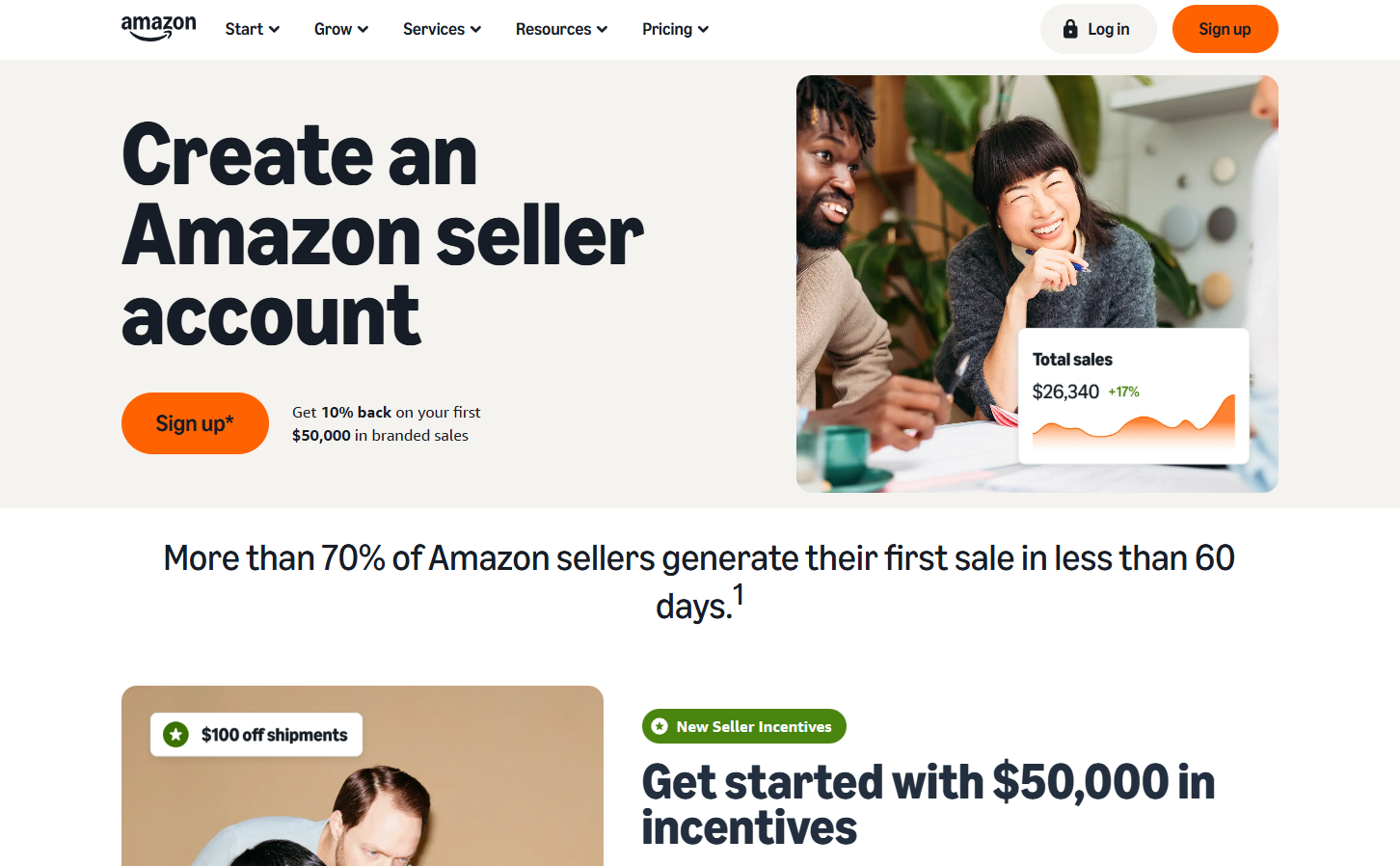
Getting started on Amazon is far simpler than most people expect. First, head to sell.amazon.com, click the sign-up button, and Amazon guides you through the entire process. You answer a few basic questions, provide standard identifying information, and as a result, you walk away with a fully active seller account. Overall, the platform is intentionally designed to onboard new sellers as smoothly as possible.
Individual Plan vs. Professional Plan

The one meaningful decision you’ll make upfront is which plan to choose. Amazon offers two options. The Individual plan is free to open but charges $0.99 for every unit you sell. The Professional plan, on the other hand, costs $39.99 per month and lets you sell unlimited products without per-item fees. Once you move more than roughly 40 units a month, the Professional plan saves you money. More importantly, it positions you as a serious seller from day one, and that matters when building supplier relationships and your Amazon presence.
What You’ll Need Before You Start
Here’s a detail most guides leave out: Amazon does not charge your monthly fee again until you actually start selling. Therefore, you can open your account, explore Seller Central, and complete your product research without the subscription clock running. Before signing up, gather a few basics, a bank account for deposits, a valid government-issued ID, your tax information, and a phone number for verification. In short, that’s all it takes to get through the door.
Once your account is live, the next question becomes the most important one you’ll face: what product are you going to sell?
Choose a Product With Proven Demand
This step makes or breaks an Amazon FBA business. Most beginners either rush it or approach it with the wrong mindset entirely. The good news, however, is that you don’t need to invent anything new. Instead, your job is to find demand that already exists, demand that real shoppers express through Amazon’s search bar every day and build a product that serves it better than what’s currently available.
How to Use Search Term Data to Find Product Ideas

SmartScout makes this research process dramatically more efficient. Its Search Term Explorer works like this: you type in a broad topic, say, pre-workout supplements, and SmartScout instantly returns a full list of related search terms that real Amazon customers use right now. Additionally, each term shows monthly search volume and competition level, giving you a clear picture of where opportunity exists.
For example, searching “pre-workout” surfaces a term like “pre-workout for women”, thousands of monthly searches, yet very few products built for that specific customer. That gap between strong demand and weak supply is exactly what you’re looking for. Furthermore, SmartScout offers a free 7-day trial through the link in the description, plus 25% off any paid plan. As a result, it’s a low-risk way to start your research immediately.
What Makes a Great First Product
Beyond search volume, a strong first product shares a few key traits. First, it’s lightweight and easy to ship, keeping logistics costs low. Second, it carries enough margin to absorb Amazon fees and ad spend while leaving real profit behind. Third, the competition is manageable, not a price war among thousands of identical listings. And most importantly, it serves a clearly underserved customer: someone searching for something specific who isn’t finding exactly what they need.
Why Passion Beats Guesswork
Search data tells you where the demand is. Passion, on the other hand, tells you which opportunity you can actually sustain. Combine both and you stop chasing random products, instead, you start building a brand. That shift separates sellers who burn out after a few sales from those who build something that grows year after year. Moreover, your connection to the customer shows up in everything: your formulation, your packaging, your listing copy, and your ability to improve the product over time. Therefore, choosing something you care about isn’t soft advice. It’s a real competitive advantage.
Find a Manufacturer Who Can Bring It to Life

Once you have a validated product idea, you need someone to make it. This step intimidates beginners far more than it should. After all, manufacturers are businesses looking for customers, just like any other business. Reaching out is straightforward. In fact, you don’t need industry connections, a large budget, or special credentials to get real quotes and start real conversations.
Sourcing Overseas
For most physical product categories, Alibaba.com is the standard starting point, and for good reason. It’s a large marketplace of manufacturers, mostly based in China, covering virtually every product type. Specifically, you can search by product, filter by certification and minimum order quantity, read buyer reviews, request samples, and message factory representatives directly. As a result, unit costs through Alibaba tend to run lower than domestic alternatives, making it a strong option for non-consumable goods like home products, fitness equipment, and accessories.
Sourcing Domestically
For consumable products, supplements, food, beverages, and personal care items domestic sourcing often makes more sense. For instance, a US-based manufacturer can provide formulation support, help navigate FDA compliance, and make the process safer for a new brand. Additionally, Thomasnet.com connects product brands with domestic manufacturers across hundreds of categories. A simple Google search like “pre-workout supplement manufacturer USA” also surfaces a solid list of options to contact directly.
How to Reach Out and Compare Suppliers
Contact several manufacturers rather than committing to the first one that responds. Specifically, ask each about minimum order quantities, unit pricing at different volumes, sample costs, lead times, and formulation support. Consequently, comparing responses puts you in a stronger negotiating position and gives you a realistic sense of fair pricing in your category. Ultimately, the right manufacturer isn’t just a one-time vendor they become a foundational part of your business.
Let Amazon Handle Fulfillment (FBA Explained)

Here’s where the business model clicks into place. Once your manufacturer finishes your units, you don’t ship them to your house. Instead, you send them directly to an Amazon fulfillment center. From that point, Amazon takes over completely. Specifically, when a customer places an order, Amazon picks the product, packs it, and ships it out. As a result, you never touch a single box.
This is what FBA – Fulfilled by Amazon – means in practice. The implications, furthermore, are significant. Your listing qualifies for Prime automatically, which boosts conversion rates because Prime members trust fast, free shipping above everything else. Additionally, Amazon handles customer service and returns. Therefore, your business can process hundreds of orders without you lifting a finger beyond monitoring your account and managing inventory.
This structure is what makes Amazon FBA so compelling as a flexible business model. Instead of running a logistics operation, you run a brand. Consequently, your time goes toward product strategy and growth, not packing tape and post office trips. Moreover, Amazon’s infrastructure scales with you automatically. Whether you sell 10 units a month or 10,000, the fulfillment process looks exactly the same from your side of the dashboard.
Before that revenue can flow, however, your product needs a listing that turns visitors into buyers.
Build Your Amazon Listing

Creating a listing inside Amazon Seller Central is straightforward. First, you log in, click “Add a Product,” and work through the fields Amazon presents. The platform guides you step by step. Nevertheless, what separates a listing that converts consistently from one that barely moves comes down to five specific elements, and getting each one right pays dividends throughout the entire life of your product.
The Five Elements of a High-Converting Listing
Your title is the first thing Amazon’s algorithm and your potential customer see. Therefore, lead with your brand name and weave in your most important keywords naturally. Next, your main image must be clean, white background, product filling the frame, no clutter. After that, your secondary images are where your real selling happens: lifestyle shots, benefit callouts, size context, and comparison graphics that help the customer picture themselves using the product. Furthermore, your five bullet points should each open with a clear benefit and answer the questions a real buyer asks before clicking “Add to Cart.” Finally, your description or A+ content tells your brand story and locks in the customer’s confidence that they’ve found the right product.
You Don’t Have to Design This Yourself
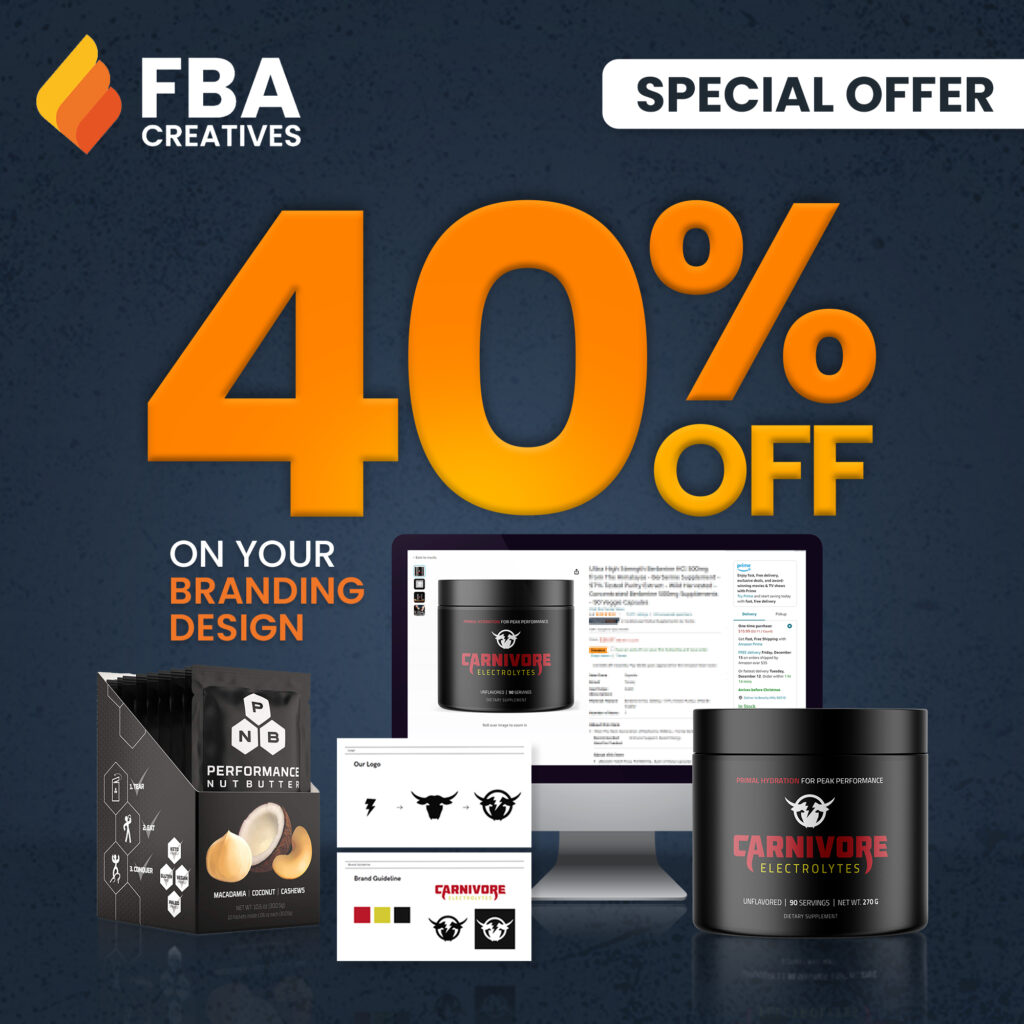
Most new sellers don’t realize this until after a disappointing launch: listing image quality is one of the single most powerful factors driving conversion rate. In fact, a mediocre product with exceptional photography beats a great product with weak visuals almost every time. Fortunately, you don’t have to develop design skills yourself. For example, FBA Creatives the team behind the packaging and listing images for Carnivore Electrolytes, a million-dollar Amazon FBA brand, handles packaging, logos, main images, lifestyle photography, and A+ content from start to finish. As a result, a discount code for their services is available in the description below.
With your listing live and your creative assets working hard, only one step stands between you and your first sale.
Launch Strong and Climb the Search Results

A product going live on Amazon does not automatically mean sales start coming in. Instead, the launch phase is where you actively drive initial sales velocity and that velocity earns you ranking. Amazon’s algorithm promotes listings that already perform well. Therefore, more early sales push your listing higher. Higher ranking, in turn, brings more organic traffic. And consequently, more organic traffic means revenue that doesn’t require additional ad spend to capture.
What a Strong Launch Actually Looks Like
A strong launch is not a single moment. Rather, it’s a concentrated push over the first two to four weeks. First, run Amazon PPC ads from day one to get your listing in front of relevant search terms immediately. Next, drive any external traffic you can from social media or email. Additionally, price competitively to encourage that critical early purchase behavior. Finally, gather your first reviews through Amazon’s compliant programs as quickly as possible. After all, reviews build the social proof that converts new visitors into first-time buyers.
Page one is the only page that matters, and that’s not an exaggeration. Amazon shoppers almost never go to page two or three. As a result, the product that wins the category holds page one. Moreover, holding page one requires the momentum that a planned, well-resourced launch builds. Therefore, every dollar you invest in that initial push buys ranking that then generates compounding organic revenue over time.
That said, knowing the six steps is one thing. Executing them in the right order, with the right decisions at each stage, is where most people find that guidance makes a real difference.
How the Passion Product Formula Puts It All Together
The six steps above are genuinely achievable for anyone starting from zero. In fact, thousands of sellers have followed this exact path and built profitable, sustainable Amazon FBA businesses. However, knowing the steps in theory and navigating the real decisions along the way are two different things. Ultimately, the quality of those decisions especially around product selection, supplier negotiation, and launch strategy, determines whether your business takes off or stalls out early.
That’s the core problem the Passion Product Formula solves. The most successful Amazon brands, after all, don’t come from people who found a spreadsheet-approved product and executed mechanically. Instead, they come from people who combined validated market demand with genuine interest in the customer they serve. Passion keeps you moving through the slow stages. Moreover, it shapes the product in ways a margin-chasing competitor can’t replicate. As a result, it turns a single listing into a growing brand with real long-term value.
What You Get Inside the Passion Product Accelerator
The Passion Product Accelerator is a mentorship program that guides you through this entire process with real support at every critical stage. Specifically, you get a proven step-by-step framework built on real results, direct coaching on your specific product decisions, guidance through supplier evaluation and negotiation, professional creative and listing support, and a launch strategy built around your product and category. In other words, you’re not following generic advice you’re getting input from people who have done this at scale and helped hundreds of other sellers do the same.
Start With the Free Resources
Best of all, you don’t need to spend anything to begin. A free 12-hour Amazon course walks through every step in genuine depth not a surface-level overview, but a comprehensive resource that delivers real knowledge before you invest a dollar. Moreover, if you want personalized support, simply book a free strategy call to learn whether the Accelerator is the right fit for where you are right now. The link is in the description below.
Your Next Step Starts Now

The path to a profitable Amazon FBA business is clearly laid out and accessible to anyone starting from scratch. Specifically, you create a seller account, find a product backed by real demand, partner with a manufacturer, let Amazon handle fulfillment, build a strong listing, and launch with enough momentum to earn your ranking. Every one of those steps is learnable. Furthermore, none require a background in business, design, or e-commerce.
The gap between where you are now and a live, revenue-generating Amazon product is smaller than most people assume. The demand is already there. Right now, 170 million Prime members search Amazon every day for products that either don’t exist yet or aren’t being done well. As a result, your product could be one of the answers they find.
Here’s exactly where to go next: first, watch the full video above for a fast end-to-end overview. Then, grab the free 12-hour Amazon course to go deeper on every step. Finally, book your free strategy call if you want direct help from a team that has guided hundreds of sellers through this journey. The tools exist. The market exists. The framework exists. The only missing piece is you taking the first step.
Frequently Asked Questions About Selling on Amazon
How much money do I need to start selling on Amazon?
Most first-time sellers launch with between $2,000 and $5,000. That typically covers an opening inventory order, professional product photography, initial PPC ad spend, and basic software subscriptions. However, some sellers start with less by choosing lower-cost categories or negotiating smaller minimum order quantities. In either case, the Passion Product Accelerator can help you build a launch budget specific to your product and situation.
How long does it take to launch a product on Amazon?
From opening your seller account to a live listing, most first-time sellers take two to four months. Most of that time, moreover, goes toward product research, supplier evaluation, sample review, and waiting for inventory to reach Amazon’s fulfillment centers. The listing itself copy, images, product details takes one or two focused work sessions once everything else is ready.
Is Amazon FBA still worth it in 2026?
Yes, clearly and confidently. The platform grows every year, and so does the Prime membership base actively spending through it. While competition has increased in saturated categories, so have the tools available to find underserved niches. As a result, sellers who research properly, build a real brand, and serve a specific customer continue to see strong, sustainable results.
Do I need to set up an LLC to sell on Amazon?
You don’t need an LLC to open a seller account or start selling. In fact, many sellers begin as sole proprietors and form a legal entity once revenue comes in consistently. That said, an LLC becomes increasingly worthwhile as your business grows, particularly for liability protection and tax planning. Therefore, talk to a business attorney or accountant to find the right structure for your situation.
What’s the difference between private label and reselling on Amazon?
Reselling means buying existing branded products from retailers or wholesalers and listing them on Amazon at a markup. Private label, on the other hand, means creating your own branded product, manufactured by a third party and selling it under your own brand name. The Passion Product Formula focuses on private label because it offers better pricing control, stronger margins, real differentiation, and the ability to build brand equity that holds value well beyond any single listing.
Do I need to know how to design my own listing images?
Not at all, and trying to do it without experience often hurts your results. In fact, high-quality listing images deliver one of the highest returns on investment in your entire Amazon business. Fortunately, FBA Creatives handles the full creative scope packaging, logo, main images, lifestyle photography, and A+ content so your listing looks professional and competitive from the very first day it goes live.