
Imagine opening a blank screen and, just minutes later, walking away with a real, six-figure product idea. That is not a fantasy, it is exactly what the right research tool can do for you. And in 2026, SmartScout may have quietly leapfrogged its competition to become the fastest way to make that happen.
So in this honest, balanced review, you will get the full picture. We will break down the pros, weigh the cons, and put SmartScout head-to-head against Helium 10 and Jungle Scout. Along the way, you will discover one tool that no other competitor offers, plus a completely free method you can use to uncover a $100,000+ Amazon FBA product.
Before we dive into the tools, though, let’s cover the two things every winning product absolutely needs.

- The Two Metrics Every Winning Product Needs
- Starting Smart – The Subcategories Tool
- Finding a Real Product Opportunity Live
- SmartScout Pricing: What's Actually Worth It
- SmartScout vs. Helium 10 vs. Jungle Scout
- Tools That Help You Find and Validate Products
- Knowing Your Competition: Brands & Sellers Tools
- Building a Listing That Wins: AI Tools
- The Free Way to Use SmartScout
- Honest Verdict – Is SmartScout Worth It?
- Your Next Step Toward an Amazon Business That Works
- Frequently Asked Questions
The Two Metrics Every Winning Product Needs

Every profitable Amazon product comes down to two numbers, and understanding them changes everything. The first is demand. In other words, you need to sell something people are already searching for. If 500 people a month type your idea into the Amazon search bar, then congratulations, you have a real market waiting for you.
The second metric is competition. An idea, no matter how exciting, is worthless if the top sellers already have thousands of reviews stacked against you. Instead, you want niches where the leading products sit at 3.7 or 4 stars, which signals unhappy customers and room to improve. Even better, you want a product idea with almost no competition at all.
Keep these two metrics in mind, because every single tool we cover next measures one of them. Once you learn to read demand and competition together, product research stops feeling like guessing and starts feeling like a system.
Starting Smart – The Subcategories Tool

Most beginners approach product research completely backwards. They immediately try to guess a single product, hoping to strike gold. However, the smarter move is to start broad and then niche down until you spot a gap that others have missed.
The Subcategories tool makes this easy. For example, if you are drawn to the supplement space, you can search “protein” and click into a broad category like sports nutrition whey protein powders. Instantly, SmartScout hands you a full dashboard: more than 600 sellers, over 300 brands, and roughly $66 million moving through that category every month. At first glance, those numbers scare people off but that reaction is exactly the mistake to avoid.
Instead of panicking, dig deeper. Click into search terms, set a maximum search volume around 4,000 to filter out the oversaturated giants, and then sort by what is growing fastest year-over-year. Suddenly, promising subniches rise to the surface, think raw organic protein powder, whey protein gummies, and high-fiber drinks.
From there, you simply click into a niche and scan the actual Amazon results. Take whey protein gummies: the top product sits at 4.5 stars with only 130 reviews, while the next seller has just five. Clearly, that is a small niche with no established players, and that kind of opening is where real money hides.
Finding a Real Product Opportunity Live
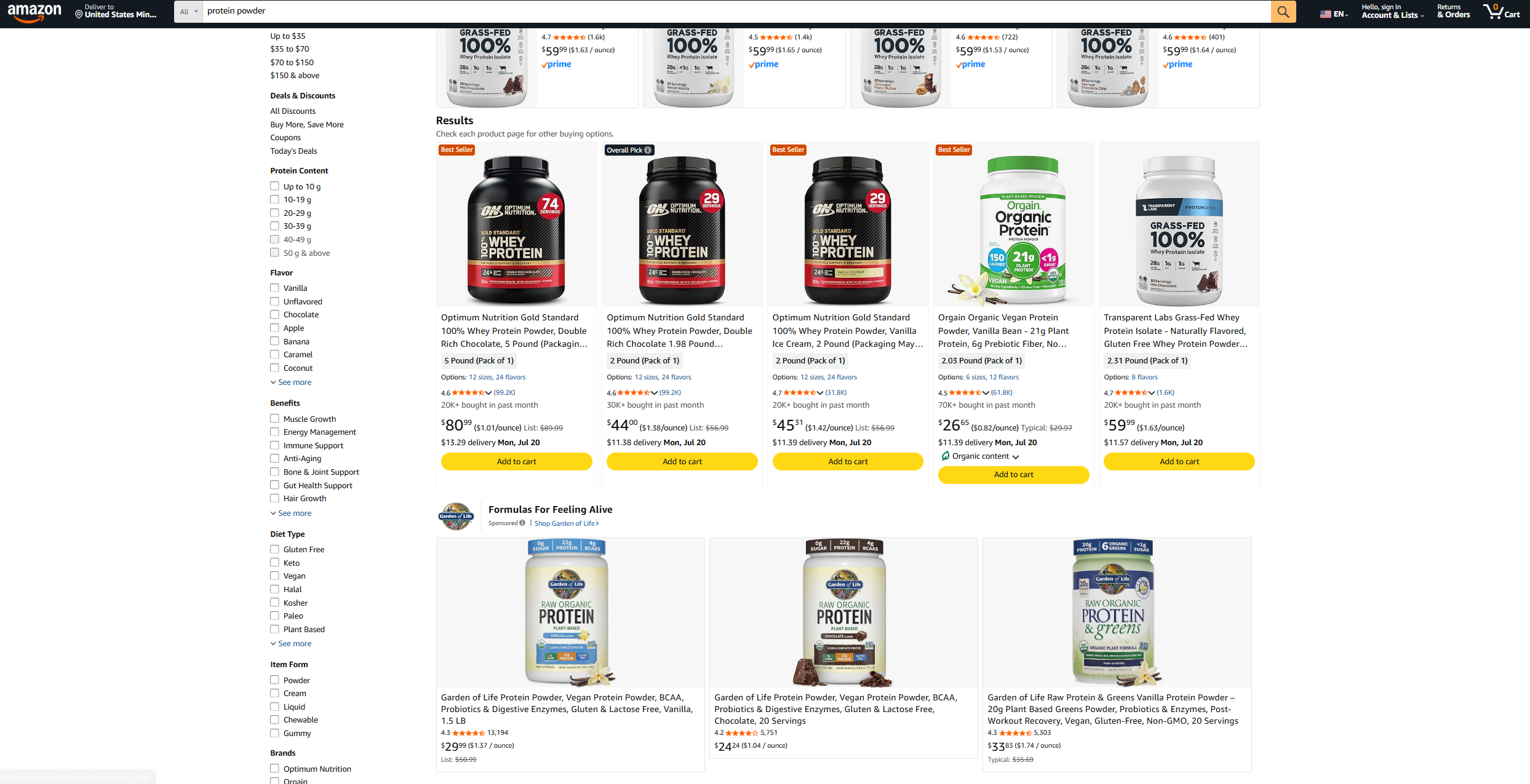
Here is where it gets exciting. After bouncing back into the niche finder, one keyword jumped out immediately: “protein powder for coffee.” With more than 8,000 monthly searches, the demand is obviously there.
But the real gold appears when you click in. Plenty of sellers offer coffee-flavored protein, yet almost no one sells protein designed to actually go into your coffee. In other words, thousands of people are searching for something that barely exists on Amazon. That is a textbook gap, high demand, fast growth, and virtually no direct competition.
This is exactly the kind of opportunity you can act on today. You can steal this specific idea outright, or better yet, apply the exact same process to any category that interests you. Either way, you now have a repeatable method for surfacing winners.
And this is precisely the thinking behind the Passion Product Formula, the gap-first approach that Travis has used to build multiple brands and help thousands of students launch successfully. SmartScout gives you the data, but the Formula gives you the roadmap for turning that data into a real product.
SmartScout Pricing: What’s Actually Worth It
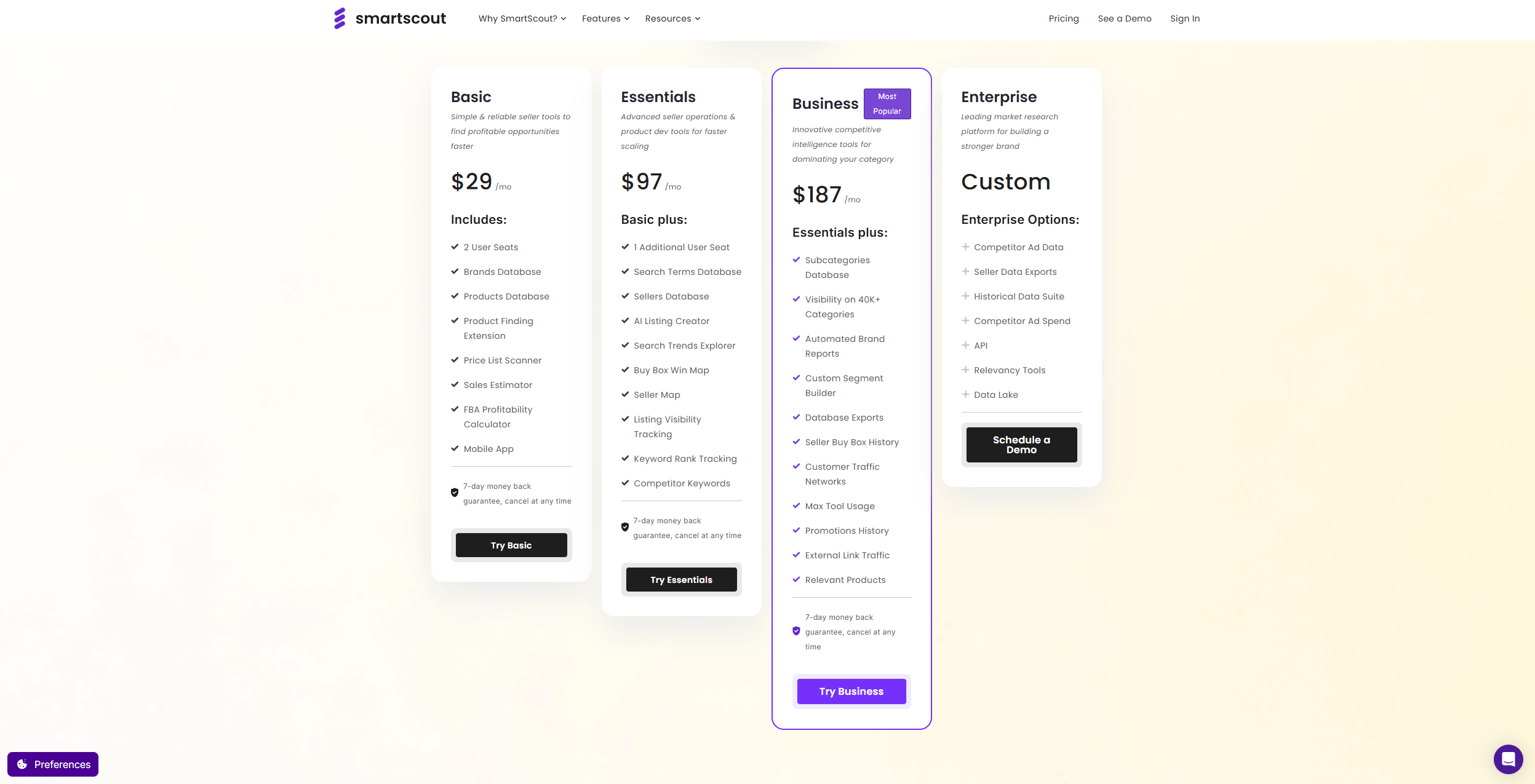
Let’s talk honestly about cost, because price is what stops most people from signing up. SmartScout offers four tiers, and not all of them deserve your money, so here is where the real value lives.
First, the Basic plan runs $29 a month, and frankly, you can skip it. You get brand and category data, but most of the powerful tools stay locked. Next, the Essentials plan at $97 a month is the sweet spot for beginners, since it unlocks the seller data and product-finding tools that actually help you make money. Above that, the Business plan at $187 a month opens everything, including Ad Spy, but you probably do not need it yet. Finally, ignore the Enterprise plan entirely for now, that one is built for large teams.
Fortunately, every plan comes with a 7-day money-back guarantee, so you can explore risk-free. On top of that, the code “Travis” gives you 25% off your first three months, and it applies automatically at checkout.
So here is the smart play: grab the free trial, stack the discount on top, and follow along as you read the rest of this review. That way, you learn by doing rather than just watching.
SmartScout vs. Helium 10 vs. Jungle Scout

You probably arrived here wondering whether SmartScout truly beats the two heavyweights. So let’s settle that fairly, because all three tools have genuine strengths and the honest answer might surprise you.
Helium 10 wins on sheer volume. It packs more tools than anything else on the market, which makes it perfect if you want one platform that does absolutely everything. However, that abundance is also its weakness, beginners often log in, see dozens of features, and freeze, unsure where to even begin.
Jungle Scout, by contrast, is the opposite. It is clean, simple, and easily the most beginner-friendly of the three, and its free sales estimator remains one of the most useful tools around. That said, it sometimes lacks depth, and a few of its numbers are not quite as precise as you would like.
SmartScout, meanwhile, is innovating the fastest. The team ships new tools almost every month, leans hard into AI, and crucially offers something the others simply cannot match: a full market view. It shows you the entire category, who owns it, how revenue splits between sellers, and what is trending inside it. That single feature is why smart research begins with a category, not a lone keyword.
Tools That Help You Find and Validate Products
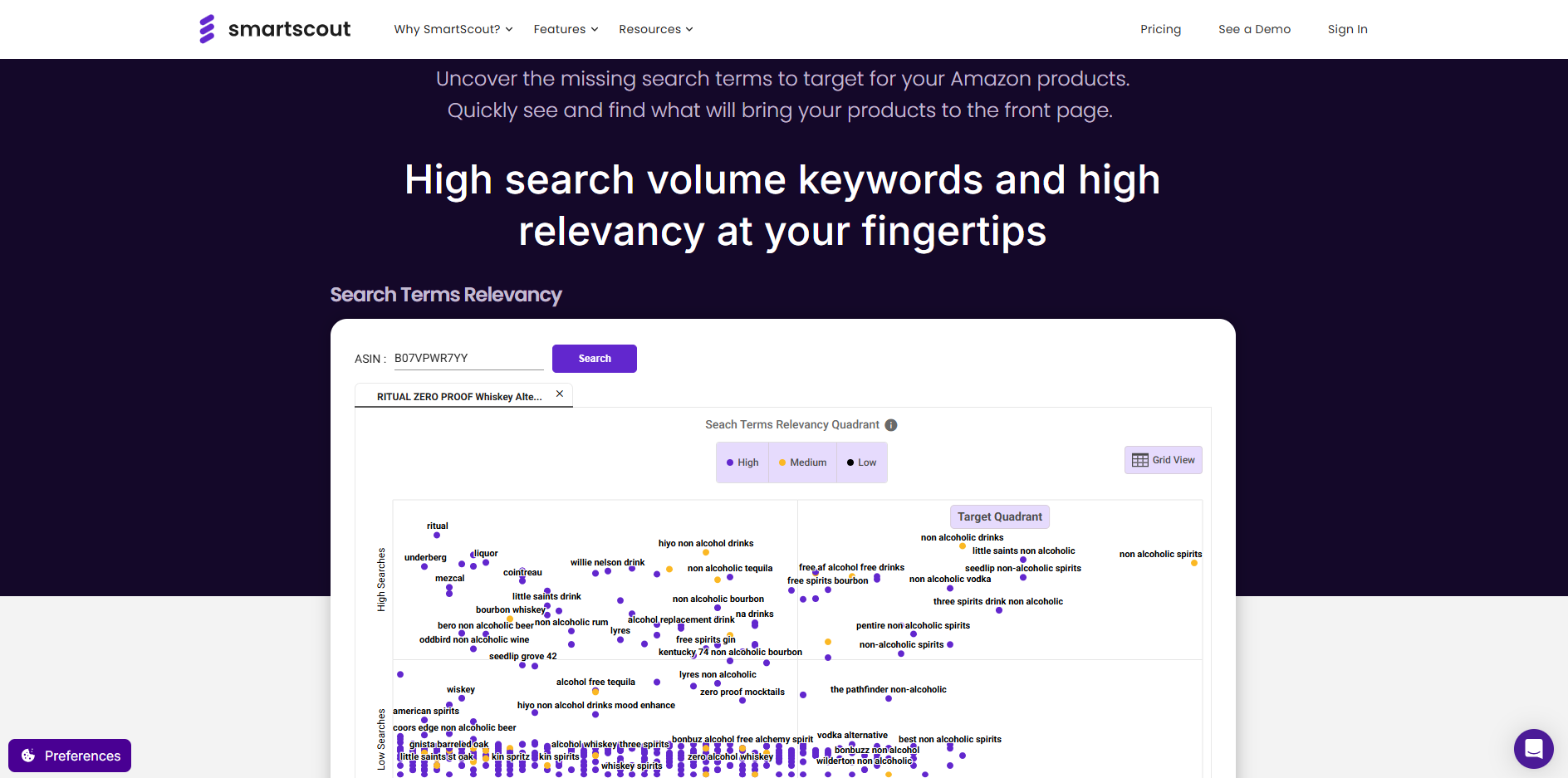
Once you understand the market, three SmartScout tools help you find and confirm real opportunities before you spend a dollar. Each one attacks demand from a slightly different angle, so together they form a powerful validation stack.
First, the Search Trend tool works like Google Trends, except it only shows what people search on Amazon which is exactly what matters. It reaches back two full years, so you can instantly tell whether a niche is a steady year-round seller, a seasonal spike, or a brand-new trend shooting straight up. Catching that early wave means far less competition when you launch.
Next, the Search Term Explorer validates demand with hard numbers: search volume, opportunity score, and CPC for every related keyword. For instance, filtering “pre-workout” surfaced “pre-workout for women” at 5,000 searches a month with almost nothing comparable on the market. Then there is RankMaker, which takes any existing product’s ASIN and reveals every phrase it ranks for plus how many sales each keyword drives, so you can spot low-competition phrases still pulling real revenue.
These tools are not just theory, either. One of Travis’s students, AJ, lost his bartending job, discovered people searching for cocktail recipe cards, and built a product called Cocktail Cards around that gap. In his first year, he cleared over $200,000 in profit, and he has since passed $1 million in combined sales. That is the power of validating demand before you build.
Knowing Your Competition: Brands & Sellers Tools
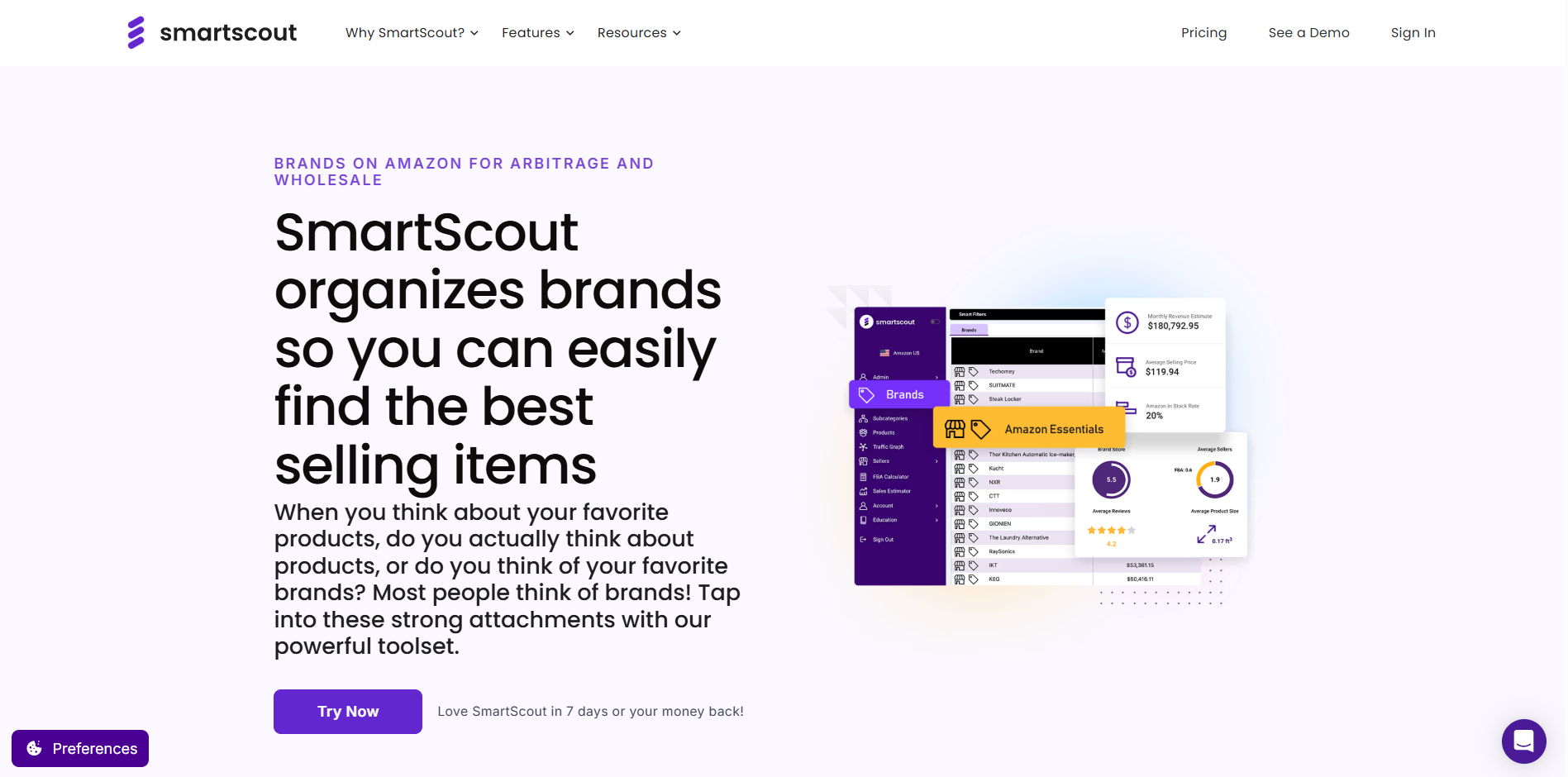
Once you know what to sell, your next job is understanding who you are up against and this is where SmartScout’s data truly shines. The Brands tool tracks over 1.5 million brands, showing estimated monthly revenue, product counts, seller counts, and roughly 19 other filters you can slice by.
The clever move here is filtering for brands with strong revenue but weak review ratings. Those brands are winning on pure demand, which means their listings are beatable. So you simply read their reviews, find what customers complain about, improve on it, and step in. That is exactly what Mina did with his MMA-focused electrolyte brand, he started with just $900 and has since done over $4 million in sales.
Beyond brands, the Sellers tool flips the view and reveals the actual sellers behind the products, along with their revenue and brand count. The Seller Map is especially motivating, because you can spot people in your own city quietly making $12,000 a month from their garage. Suddenly, the whole goal feels achievable rather than distant.
Finally, a tool almost nobody uses
Segments lets you build a custom group of competitor products and monitor that corner of the market from one dashboard. So once you pick your niche, keeping tabs on the competition becomes effortless.
Building a Listing That Wins: AI Tools
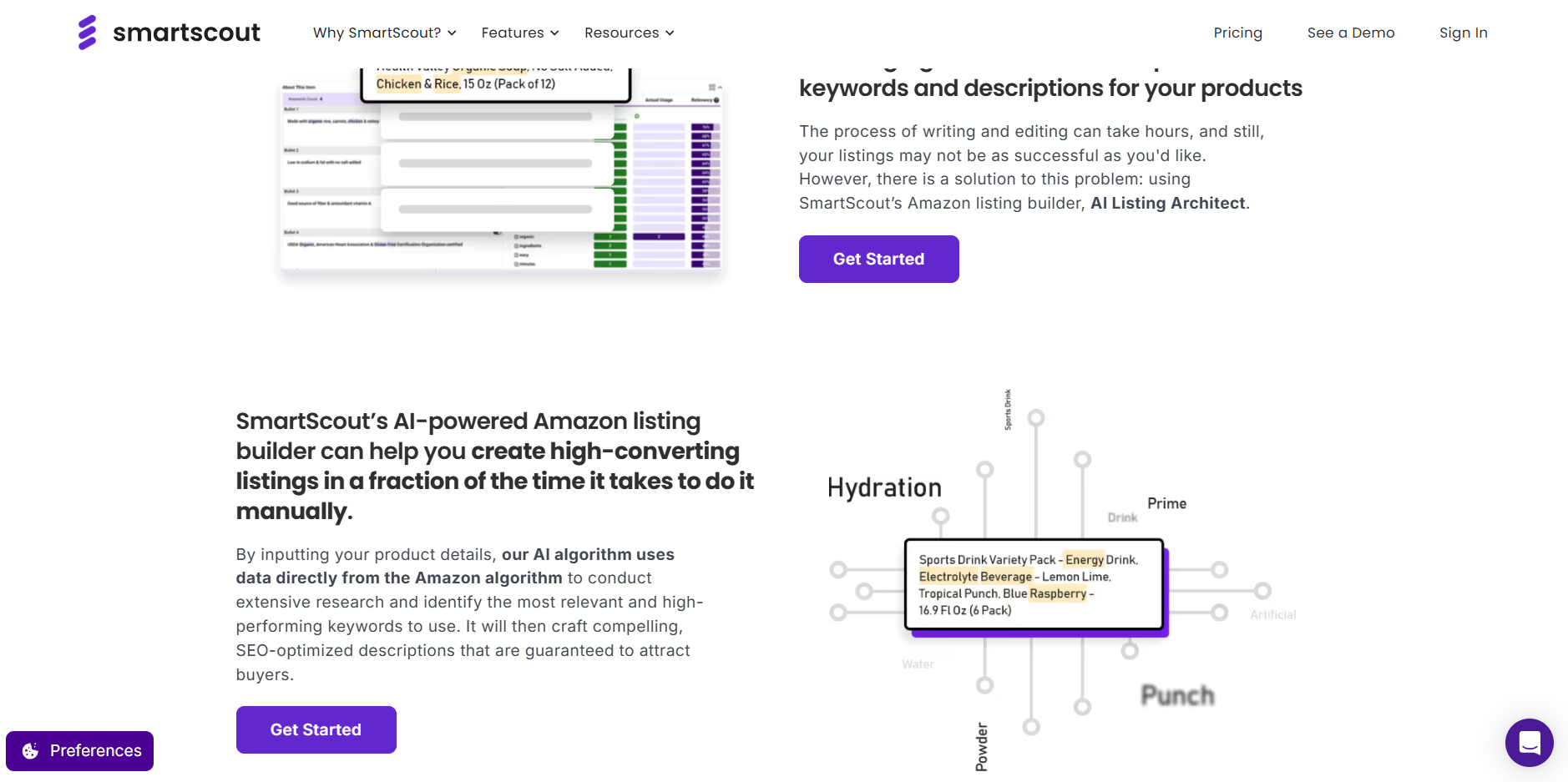
After you find and validate a product, you need a listing that beats the competition and SmartScout offers two AI tools built for exactly that. The AI Listing Builder analyzes an existing listing or three to five competitors, pulls every phrase they rank for, and then writes you a title, bullet points, and description built around those keywords with one click. You should never blindly copy and paste AI output, of course, but as a first draft it handles a huge amount of the heavy lifting.
The real standout, though, is the AI Scorecard, a tool no competitor currently offers. To understand why it matters, consider what is changing on Amazon right now. Amazon built its own AI shopping assistant, Rufus, which reads your listing and judges how well it answers what shoppers actually need.
SmartScout took Amazon’s own published paper on this and turned it into a living scorecard. It runs your listing through roughly 15 buyer-intent questions, scoring both your copy and your images. Even better, you can paste in a top competitor, run it through, and instantly see everything their listing is missing.
As a result, you get a clear blueprint for building a listing that outperforms a brand already winning. Often, you do not even need a better product, just a better listing than someone who got lazy. For launch planning, Ad Spy rounds things out by revealing any competitor’s paid keywords and estimated ad spend.
The Free Way to Use SmartScout
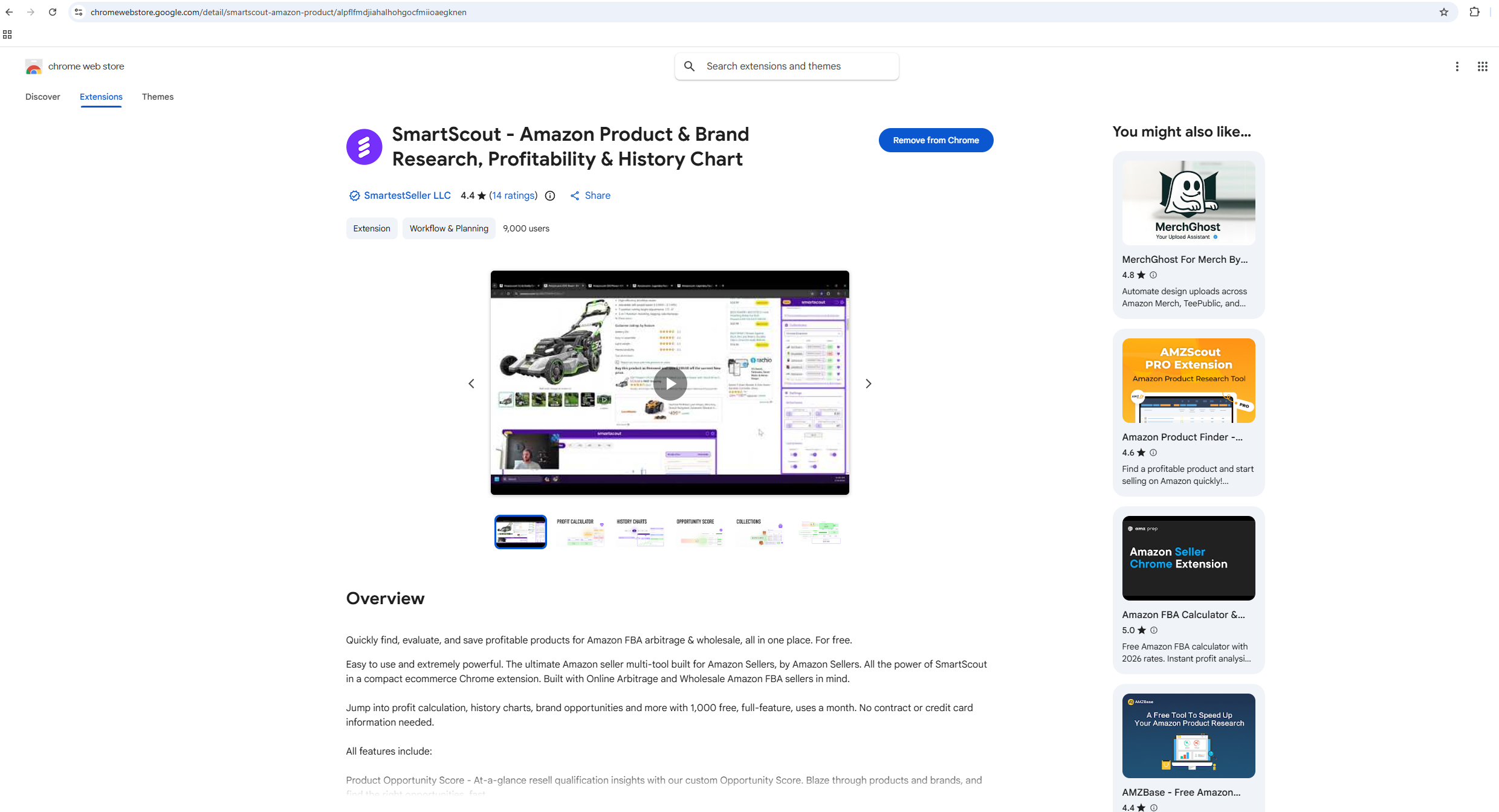
Now for the promise from the start, a completely free way to use SmartScout. The free Chrome Extension gives you up to 1,000 uses a month, and for many people it becomes the piece they rely on most.
Using it could not be simpler. You browse Amazon like a normal shopper, click the extension on any product page, and it instantly drops all the key data right on top. You immediately see the page score, the BSR, revenue and units sold over the last 30 days, the price history, and every phrase the product ranks for.
The built-in calculator, however, is the real gem. You type in what you can source the product for, and it shows your profit, margin, and potential revenue with every Amazon fee already deducted. In short, you get serious research power without spending a cent.
So between the free extension and the free trial, you can genuinely test the entire platform for nothing before committing to a paid plan.
Honest Verdict – Is SmartScout Worth It?
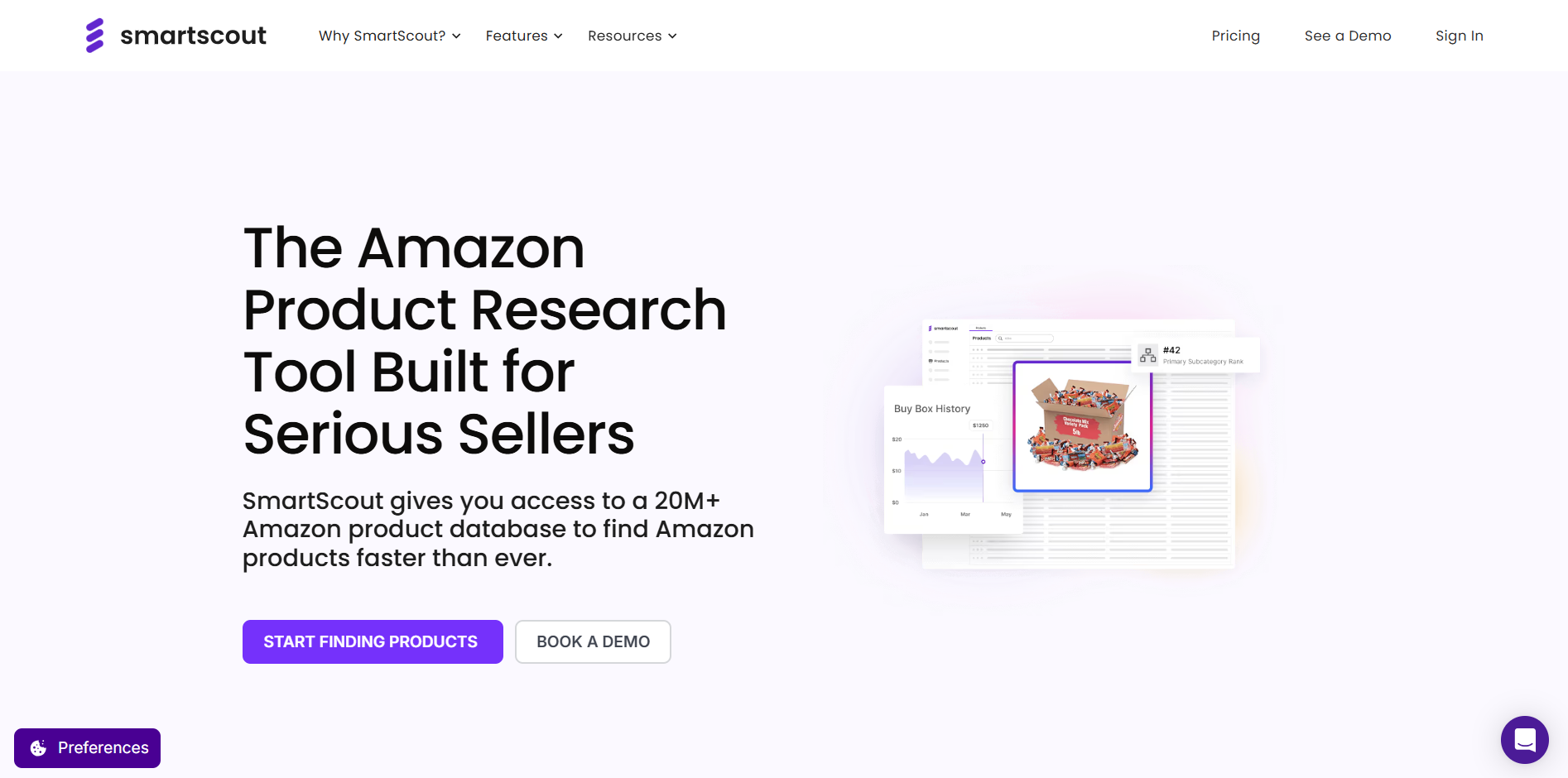
Now that you have seen everything SmartScout does, what it costs, and how it stacks up, here is the honest verdict. If your goal is to find uncompetitive niche opportunities, validate those markets before spending anything, and see categories, brands, sellers, and trends all in one place, then yes it is absolutely worth it.
The market view alone is something Helium 10 and Jungle Scout simply cannot match. Add the AI Scorecard and the trend tools neither of which exists in the competing platforms and SmartScout pulls clearly ahead for serious product research.
Finally, reframe the cost in your mind. One winning product easily pays for years of this tool, if not its entire lifetime. So investing a little more upfront is a small price for finding a product people already want. Remember, the code “Travis” gets you 25% off your first three months.
Your Next Step Toward an Amazon Business That Works

Ultimately, SmartScout is a genuinely powerful tool but a tool is only ever as good as the strategy behind it. Data alone will not build your business; a proven, step-by-step system will. That is exactly where the Passion Product Formula comes in.
The Formula combines everything you just learned finding gaps, validating demand, and studying competitors with a complete blueprint for launching a product you are actually passionate about, profitably. It is the same system Travis has used to generate over $10 million in online sales and help thousands of students build their own Amazon FBA brands from scratch.
So if you are serious about launching, do not go it alone. You can apply for a free strategy call with Travis or one of his top coaches, where you will map out an exact plan to find success on Amazon over the next six months. Spots are limited, so it is worth applying sooner rather than later.
Your first $100,000 product idea might be just one search away. So take what you have learned, pair it with a proven system, and go find your gap in the market.
Frequently Asked Questions
Is SmartScout better than Helium 10 and Jungle Scout?
It depends on your goals. Helium 10 offers the most tools overall, while Jungle Scout is the most beginner-friendly. However, SmartScout stands out for its full market view, its fast pace of innovation, and AI features like the Scorecard that the other two simply do not have.
Can I really use SmartScout for free?
Yes. The free Chrome Extension gives you up to 1,000 uses per month, and every paid plan includes a 7-day money-back guarantee. Between the two, you can test the entire platform at no cost before committing.
Which SmartScout plan should a beginner choose?
The Essentials plan at $97 a month is the best starting point. It unlocks the seller data and product-research tools you actually need, whereas the $29 Basic plan keeps most of the valuable features locked.
How do I get the SmartScout discount?
Use the code “Travis” at checkout to receive 25% off your first three months. The discount applies automatically when you sign up through the link, and you can stack it on top of the free trial.
What makes the AI Scorecard so special?
The AI Scorecard is built around Amazon’s own Rufus AI and its published research. It scores your listing’s copy and images against roughly 15 buyer-intent questions, then reveals exactly what your top competitors are missing, giving you a clear blueprint to outperform them.
Do I need a research tool to succeed on Amazon?
Not strictly. Plenty of students have succeeded without one. That said, tools like SmartScout make validating products far faster and easier and when you pair them with a proven system like the Passion Product Formula, your odds of building a profitable brand improve dramatically.