As an Amazon FBA beginner, you should know that Amazon generated over $620 billion in sales in the last twelve months. Experts project that number to climb past $700 billion by the end of 2025. That growth is not just a testament to Amazon’s dominance. It is an open invitation. Every day, regular people with no prior business experience build profitable income streams on Amazon. The opportunity is real. It is growing. And it is available to anyone willing to follow a proven system.
This guide breaks down everything covered in Travis Marziani’s free Amazon FBA course. Travis is a seven-figure Amazon seller. He has helped over 2,000 students launch successful products. He and his team lay out every step in plain, actionable language. Whether you are brand new to e-commerce or you have tried selling online before, this post gives you the full roadmap.
By the time you finish reading, you will know how to find a winning product. You will know how to source a manufacturer and set up your business legally. You will also learn how to build an audience, create your Amazon FBA listing, ship your inventory, and run ads. More importantly, you will see exactly why the Passion Product Formula consistently produces results where other methods fall short.
- Why Amazon FBA Is Still One of the Best Opportunities in 2026
- How Amazon FBA Works
- The 7 Product Research Methods
- The Passion Product Advantage
- How to Find a Manufacturer
- Setting Up Your Business Legally
- Using Social Media to Build Pre-Launch Momentum
- Creating Your Amazon Listing and Navigating Seller Central
- Shipping to Amazon's Fulfillment Centers
- Amazon PPC and Advertising Strategy
- Your Amazon FBA Success Starts Here: Take the Next Step
- Frequently Asked Questions
Why Amazon FBA Is Still One of the Best Opportunities in 2026

E-commerce is not slowing down. Back in 2019, Americans spent roughly $500 billion shopping online. By 2024, that number had more than doubled to $1.2 trillion. Projections for 2025 put it at $1.38 trillion. That consistent upward climb means the market expands every single year. Anyone selling products online benefits directly from that growth.
Amazon sits at the center of this expansion. It captures approximately 50% of all U.S. e-commerce sales. Over 200 million Prime members shop on the platform worldwide. Roughly one in two Americans holds a Prime subscription. When someone wants to buy something online, Amazon is almost always their first stop. That built-in traffic is something no independent store can replicate on its own.
The proof is not just in the macro numbers. Travis launched Carnivore Electrolytes as a side project. He expected maybe $100 in revenue per day. Instead, the product grew to generate over $90,000 in a single 30-day period. Profit margins sat around 50%. That is not an outlier. It is the result of applying a repeatable formula to a well-researched product in an underserved niche.
Amazon FBA businesses are also sellable assets. Travis previously sold his Performance Nut Butter brand for around one million dollars. Many of his students have done the same. Building an Amazon FBA business is not just about monthly income. It is about creating real equity you can eventually exit. That gives you options a traditional job simply cannot offer.
How Amazon FBA Works
FBA stands for Fulfillment by Amazon. The concept is straightforward. You source a product and ship your inventory to one of Amazon’s fulfillment centers. Amazon then handles everything after a customer clicks “Buy Now.” They pick the product, pack it, ship it, and manage customer service. You collect the profit while Amazon does the heavy lifting.
The fulfillment flow works like this. You place an order with your manufacturer. Your manufacturer ships the units directly to Amazon’s warehouse. Amazon FBA stores your product until it sells. When a customer orders, Amazon dispatches it with Prime two-day shipping. That Prime badge is not just a perk. It is a conversion driver that directly increases your sales volume.
The alternative is FBM, or Fulfilled by Merchant. With FBM, you store and ship products yourself. For most sellers building a passive income model, FBM defeats the purpose entirely. One of the biggest advantages of FBA is that it lets you run your business remotely. Travis himself works fewer than 20 hours per week across his entire Amazon FBA operation.
Understanding this model matters because it shapes every decision you make downstream. It affects how you package your product. It also affects how much inventory you order at a time. Once you grasp the mechanics, the rest of the process becomes much easier to follow. And the single most important decision in your Amazon FBA journey is the product you choose to sell.
The 7 Product Research Methods

Product research is where most beginners get stuck. The idea of finding one winning product among millions feels overwhelming. Fortunately, there are seven proven methods you can use to find a great idea. You can use them individually or combine them for even better results. Most require nothing more than a free Amazon account and a Helium 10 subscription.
The Keyword Method (Helium 10 Magnet Tool)
The Magnet tool inside Helium 10 is one of the most powerful starting points for product research. You begin by entering a broad seed keyword. The tool returns hundreds of related keywords that real shoppers are actively searching for. From there, you apply filters to narrow down the results.
Set a minimum search volume of 300 per month. Look for a Magnet IQ score at least three times higher than the search volume. Keep your keyword word count between two and five words. These filters quickly separate promising opportunities from oversaturated dead ends.
The Magnet IQ score is the key metric to watch. It measures search demand relative to competition. A high score compared to search volume tells you people are searching for something that few sellers currently offer. A search around “tallow” surfaced “wagyu fat spray” with a Magnet IQ score more than 20 times its search volume. That signals low competition and real demand at the same time.
Also pay attention to the CPR score. It tells you how many sales you need in 8 days to rank on the first half of page one. A CPR of 8 is the lowest shown. It means just one sale per day can get you there. That is an achievable target for any new seller with a focused launch strategy.
The Bestseller Method
Amazon FBA publishes its best-selling products publicly. You can use this data to your advantage completely for free. Instead of browsing the overall bestsellers, navigate to the “New Releases” tab within specific categories. This section highlights products that launched within the last 60 days and are already generating strong sales.
These products signal active markets. They are not yet locked down by entrenched competitors. For example, a simple pet ear wipe product with only 54 reviews was already generating 600+ sales per month. That is clear demand without fierce competition. Always combine this finding with Helium 10‘s trend data. This confirms whether interest is seasonal or year-round before you commit.
Blackbox Tool
Unlike the Magnet tool, Blackbox lets you discover products when you have no starting idea. You select a category and set your filters. Target a price range between $15 and $85. Set the average review rating below 4.2 stars. Filter for monthly revenue between $3,000 and $100,000. The tool then surfaces product opportunities that meet your exact criteria.
The review rating filter is especially strategic. Any product averaging below 4.2 stars rounds down to four stars in Amazon’s display. Customers see a four-star product. You enter the market with a better version and immediately stand out. One example from the course was an inflatable snowmobile sled. It was rated 3.7 stars but still generated $6,000 in monthly revenue. A five-star version could easily dominate it.
Cerebro Tool
The Cerebro tool flips the research process around. Instead of starting with a keyword, you start with a competitor’s product. Grab the ASIN from a product that is already selling well. Plug it into Cerebro. The tool reveals every keyword that product ranks for. It gives you a full map of demand in that space.
From there, look for adjacent keywords that are underserved. Find terms with solid search volume and a high Cerebro IQ score. Also check for a low CPR. A great example from the course was “pedometer for seniors.” It had 350 monthly searches and a CPR of just 8. No product on Amazon FBA was specifically marketed toward seniors. The first seller to target that keyword could dominate it with minimal effort.
The Search Bar Method
This method is one of the simplest and most underused research tools available. Go to Amazon’s search bar and start typing letters or partial words. Amazon’s autocomplete surfaces the top search queries in real time. It reveals exactly what customers are actively looking for right now.
By going a few characters deep, you uncover more specific and less obvious keywords. This is exactly how the team discovered Berberine Tea. They typed “BE” into Amazon’s search bar and saw “berberine” appear in the suggestions. They then typed “berberine t” and saw “berberine tea” pop up. It was a niche with real demand and virtually no targeted competition. Today, their Berberine Tea ranks at the top of Amazon for that keyword. It generates around $2,000 in monthly revenue with a 50%+ profit margin and almost zero PPC spend.
Google Trends and Keyword Planner
Google Trends gives you a macro-level view of consumer interest over time. It measures Google searches rather than Amazon FBA searches. However, the underlying consumer behavior is largely the same. By comparing multiple trends side by side, you can identify markets that are rising versus those that have already peaked.
Travis used this tool to time his entry into the carnivore diet market perfectly. The trend was climbing sharply at exactly the moment they launched Carnivore Electrolytes. Google Trends also showed that the keto diet had peaked and was declining. Travis sold Performance Nut Butter at the right time. He then reinvested into the carnivore niche while it was still on its way up. That kind of timing gives you a major strategic edge over competitors.
Exploding Topics (Bonus Method)
Exploding Topics is a curated trend-tracking platform. It surfaces topics experiencing explosive growth before they become mainstream. The free homepage reveals opportunities like Shilajit honey, 99x growth in one year. Bamboo pajamas showed 1,600% growth. These products are gaining serious momentum right now. Early sellers can establish dominance before the market fills up.
The real power comes from combining this tool with Helium 10. Spot a trending topic on Exploding Topics. Take that keyword directly into the Magnet tool. Validate the demand, check the competition level, and identify adjacent niches to target. This two-step process helps you find products with both current momentum and long-term staying power.
The Passion Product Advantage

Generic private label selling is increasingly difficult to make work. The model involves finding a commodity product on Alibaba and putting your logo on it. You then compete in a crowded market on price. Chinese manufacturers list directly on Amazon at prices domestic sellers cannot match. Rising tariffs are widening that cost gap further. Competing on price is a race to the bottom, and most beginners cannot win it.
The Passion Product approach takes a completely different angle. Instead of finding a generic product and adding a label, you start with your own interests and knowledge. You build a product that serves a specific audience in a way nothing else currently does. Carnivore Electrolytes did not compete with dozens of generic electrolyte products. It created its own category by speaking directly to people on the carnivore diet.
The results speak for themselves. AJ Rantz was a former bartender. He used his expertise to create Cocktail Cards, a flashcard deck of cocktail recipes. He generated $170,000 in profit in his very first year. Brent was a helicopter pilot and first responder. He built Stir Pro into a $1.7 million revenue business in two years. He did this while working full time. These are not people with business degrees or startup funding. They combined personal expertise with the Passion Product system and executed consistently.
Passion Products also require far less PPC spend. They occupy a unique niche with little direct competition. They rank organically without needing to outbid dozens of rivals. Travis’s team spent just $890 on PPC against nearly $80,000 in sales. That is roughly 1% of revenue. That level of efficiency is simply not possible with a generic product in a saturated market.
How to Find a Manufacturer
Once you have validated your product idea, the next step is finding someone to make it. Manufacturing is far more accessible than most beginners expect. Several platforms and strategies make the process manageable, even if you have never done it before.
Alibaba
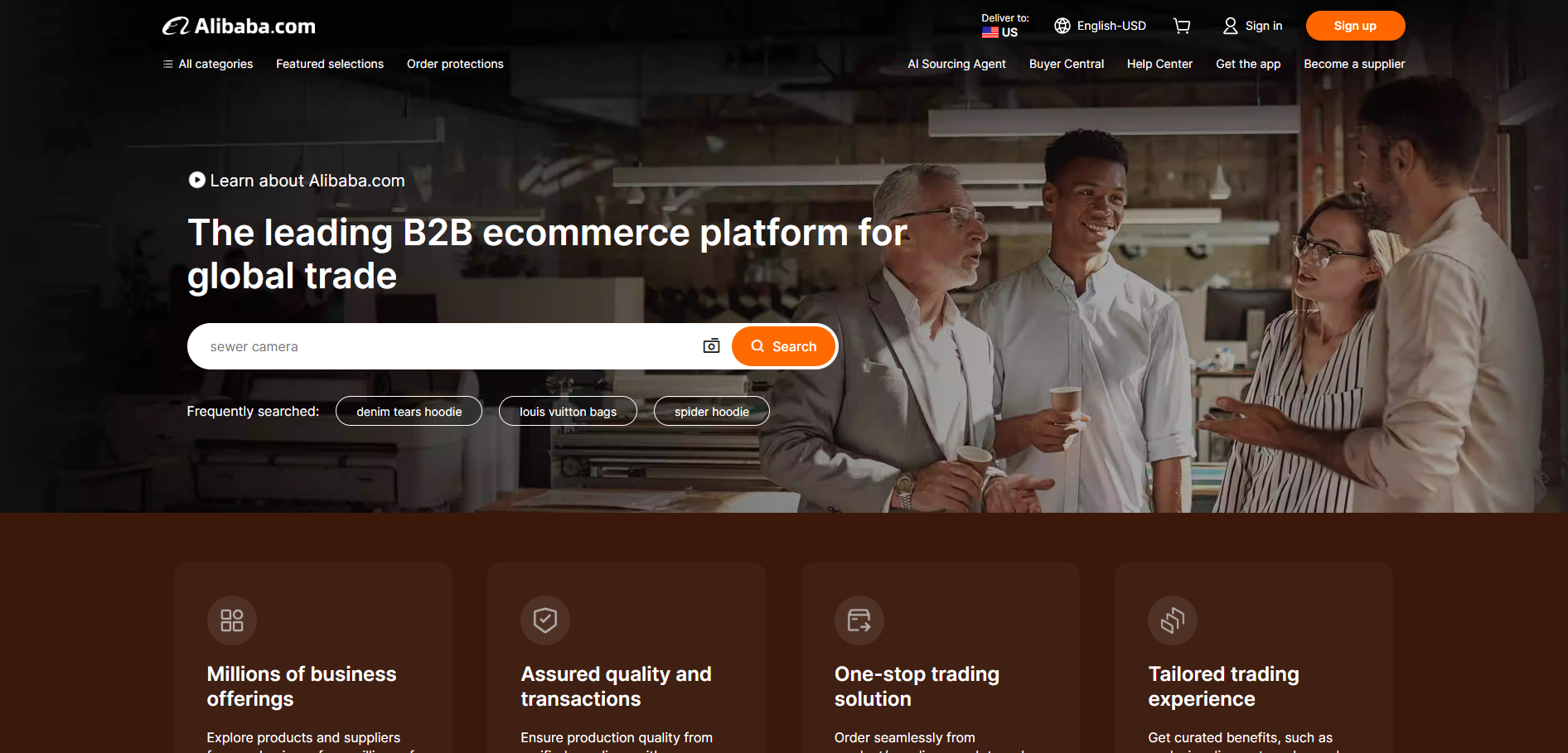
Alibaba is the most well-known manufacturing marketplace in the world. It connects buyers with suppliers primarily based in Asia. When searching, always filter for “Verified Suppliers” or “Verified Pro Suppliers.” These designations mean a third-party company has physically visited the factory and confirmed its legitimacy. Prioritize suppliers who have been active for at least two years. This indicates a track record of working with buyers successfully.
For your first order, aim for an MOQ of 500 to 1,000 units. This gives you enough inventory for a strong launch without over-committing. Larger suppliers may not accommodate lower MOQs. Look for suppliers with annual revenue in the $500,000 to $1 million range. They tend to be more flexible and more eager to build long-term partnerships with growing brands.
Before placing any order, have your supplier sign an NNN agreement. NNN stands for Non-Disclosure, Non-Use, and Non-Circumvention. It holds more weight in Chinese courts than a standard NDA and it’s inexpensive to obtain. It also provides meaningful protection against idea theft. Alibaba’s Trade Assurance feature acts as an escrow service. It holds your payment until the order meets your agreed-upon specifications.
US-Based: ThomasNet
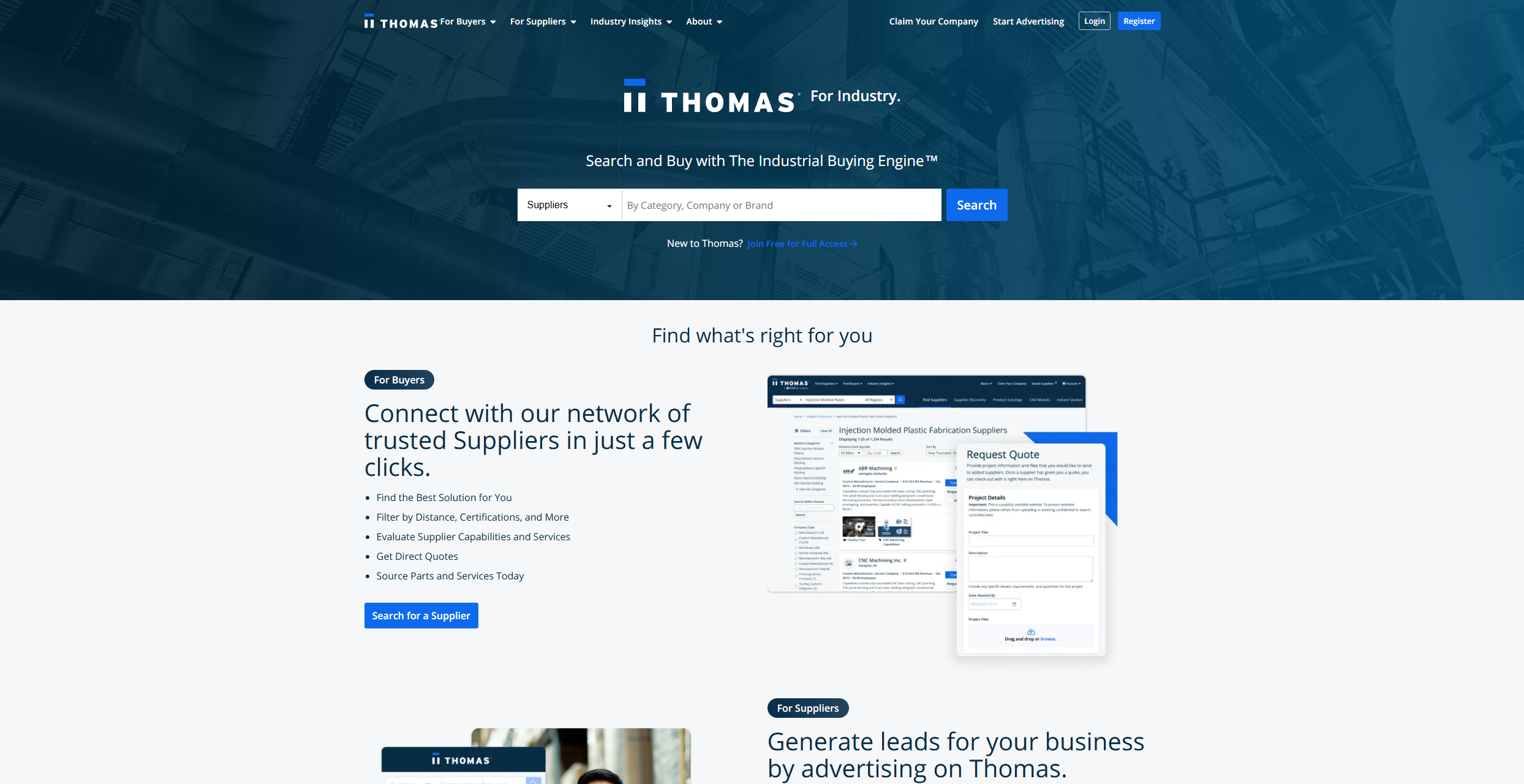
ThomasNet.com is the go-to resource for finding U.S.-based manufacturers. Domestic manufacturing typically costs more per unit. However, it offers real advantages. Lead times are shorter. You can visit your supplier in person. Quality certifications are easier to verify. You can also market your product as “Made in USA,” which resonates strongly with many buyers. Filter suppliers by quality certifications like ISO 9001 and by proximity to your zip code.
Global Options
Several other platforms serve different regions. For Mexico and South America, gima.com is a strong resource. Then for India, indiamart.com connects you with a wide range of manufacturers. For Europe, europages.com is the continent’s largest manufacturing directory. Global Sources is another excellent option. It focuses exclusively on verified manufacturers rather than trading companies. This reduces the risk of working with a middleman posing as a factory.
Trade Shows
Trade shows offer something no online platform can replicate, face-to-face relationships. Attending industry expos gives you direct access to suppliers. You can inspect product samples in person. You can network with other sellers who can refer trusted manufacturers. For anyone serious about building a long-term brand, connections made at a single trade show can be worth more than months of online outreach.
Setting Up Your Business Legally

Building a legitimate Amazon FBA business requires more than a great product. You also need the right legal and financial infrastructure from the start. Fortunately, the setup process is simpler than most people assume. Getting it right early protects you significantly down the road.
The first step is choosing a business structure. For most beginners, forming an LLC is the right move. An LLC separates your personal assets from your business assets. If something goes wrong-a lawsuit, a debt, or a dispute, your personal savings and property are protected. Costs vary by state. They range from roughly $150 to $800 per year. If you live outside the United States, Wyoming is a popular option through services like wyregisteredagent.com.
Once your LLC is formed, obtain an EIN from the IRS. This is completely free. It takes about 10 to 15 minutes at IRS.gov. It functions as a social security number for your business. You will need it to open a business bank account and apply for credit cards. A business bank account keeps your finances clean. A business credit card gives you the cash flow flexibility to place larger inventory orders as your business grows.
A seller’s permit is another essential step that many new sellers overlook. It is free to obtain. It helps you comply with state sales tax regulations. More importantly, it makes your business tax-exempt on inventory purchases. When you order from Alibaba, you pay no sales tax on those goods. You collect that tax from your end customers instead. Over multiple inventory orders, this adds up to meaningful savings.
Using Social Media to Build Pre-Launch Momentum

One of the biggest advantages a Passion Product seller has over a generic private label seller is the ability to build an audience before launch day. Social media makes this possible for free, and when used strategically, it can transform a product launch from a slow crawl into a rocket ship takeoff.
AJ’s story is the clearest proof of what is possible. Starting with zero followers and zero budget, AJ began posting TikTok videos about cocktail-making using his years of bartending experience. He stayed consistent, posted daily, and channeled viewers into his email list and eventually his Indiegogo campaign. By the time his Cocktail Cards product was ready to ship, he had raised nearly $100,000 in pre-orders from people who already loved his content. That is the power of building an audience before you need it.
The four core social media strategies worth mastering are short-form content, influencer marketing, a pre-launch group, and viral hacking. Short-form content on TikTok, Instagram Reels, and YouTube Shorts is where the algorithms are currently sending the most organic traffic, meaning you do not need to spend money on ads to reach thousands of people. The key is to start with a strong hook, keep your content tight and energetic, post every single day, and always direct viewers toward a specific action, joining your email list, following your account, or visiting your product page.
Micro-influencers are another underutilized lever, especially for sellers who are not yet comfortable on camera themselves. Influencers with between 1,000 and 100,000 followers are often willing to promote a product in exchange for a free sample and an affiliate commission, no upfront payment required. Because these creators have smaller but highly engaged audiences in specific niches, their endorsements often convert better than those of larger celebrities. Travis’s team worked with over 500 micro-influencers to promote Carnivore Electrolytes, and many of those partnerships cost nothing beyond the product itself.
Creating Your Amazon Listing and Navigating Seller Central

Your Amazon listing is your storefront, and it does the selling for you 24 hours a day. A well-built listing with strong images, keyword-rich copy, and clear bullet points will consistently outperform a mediocre listing even if the underlying products are identical. Investing time and effort into your listing is one of the highest-return activities in your entire business.
To create a listing, navigate to Amazon Seller Central, go to Manage All Inventory, and click Add a Product. You will need a UPC barcode (available from GS1 for about $25) to identify your product, and Amazon will generate a unique FNSKU barcode for your listing once it is created. Your product title should be descriptive and keyword-rich, think about what your ideal customer would type into the search bar and build your title around those exact phrases. Tools like Helium 10 make this process much more precise by showing you exactly which keywords carry the most search volume for your niche.
Bullet points are your opportunity to answer the most important questions a buyer might have before purchasing. Lead with your product’s strongest benefit in each bullet, and back it up with a brief explanation. Your product description, while less prominently displayed, gives you space to tell your brand story and reinforce the keywords you want to rank for. Every field you fill out thoroughly increases Amazon’s ability to match your listing to relevant search queries.
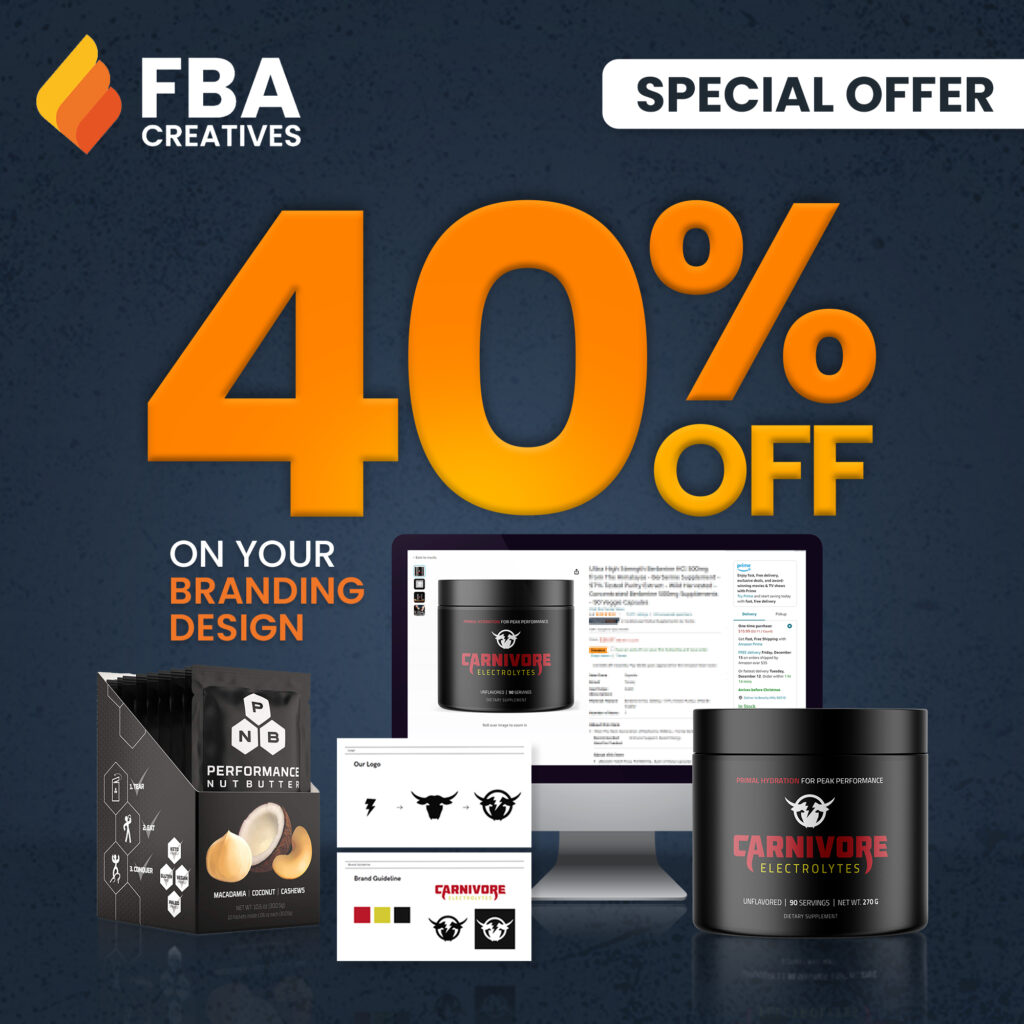
Images deserve special attention because online shoppers cannot touch or test your product, their buying decision is almost entirely visual. Invest in professional, realistic product photography or high-quality 3D mockups that showcase the product from multiple angles and in lifestyle contexts. The team uses FBA Creatives for their own listings, and the results are visible in the polished, cohesive look of the Carnivore Electrolytes product page. Beyond your main listing, Seller Central also gives you access to A+ content (enhanced brand content with images and comparison charts), a branded storefront, Vine enrollment for early reviews, and deals and coupons to drive promotional sales.
Shipping to Amazon’s Fulfillment Centers
Getting your inventory into Amazon’s warehouse is the bridge between having a product and making sales. The process is more straightforward than it looks once you have done it once, and understanding a few key details upfront can save you significant time and money.
Every unit you send to Amazon must have an FNSKU barcode on it. This is Amazon’s internal identifier for your specific listing, and without it, the warehouse cannot match your inventory to your product page. The most cost-effective way to handle this is to have your manufacturer print the FNSKU directly onto your packaging before shipping, this costs nothing, whereas having Amazon apply labels for you costs $0.55 per unit. On a shipment of 500 units, that is $275 you can keep in your pocket simply by planning ahead.
To create a shipment, go to Manage All Inventory in Seller Central, click the options menu next to your product, and select “Send or Replenish Inventory.” You will set up a shipping template that specifies your box dimensions, weight, and the number of units per box. Amazon requires each box to weigh under 50 pounds and contain fewer than 150 units. Once your template is confirmed, Amazon will assign you fulfillment center locations and generate shipping labels for each box.
For most beginners shipping domestically, the simplest option is to drop your labeled boxes off at a UPS location and let Amazon’s preferred carrier handle the rest. If you are shipping from overseas, working with a freight forwarder is strongly recommended, they handle customs, documentation, and logistics coordination, which removes enormous complexity from the process. Sea freight is cheaper but slower (typically four to six weeks); air freight is faster but significantly more expensive. Either way, always photograph your shipments, keep your receipts, and track your shipment through Seller Central’s Shipping Queue, as issues do occasionally arise and your documentation is your protection.
Amazon PPC and Advertising Strategy
Amazon PPC (Pay-Per-Click) advertising allows you to pay for sponsored placement at the top of search results. For most products in competitive markets, PPC is a necessary expense to generate initial visibility. However, one of the most compelling advantages of the Passion Product approach is that a well-positioned product in an underserved niche requires remarkably little ad spend to thrive.
Travis’s Carnivore Electrolytes account spent just $890 on PPC during the same period it generated nearly $80,000 in sales, an advertising cost of roughly 1% of revenue. That efficiency is possible because the product ranks organically for its target keywords without needing to outbid dozens of competitors. By contrast, a generic supplement seller in a crowded category might spend 30 to 40% of revenue on PPC just to stay visible. This difference fundamentally changes how profitable your business can be.
That said, running some PPC campaigns, especially early on is still valuable. Start with an automatic targeting campaign, which lets Amazon’s algorithm determine which keywords to target based on your listing content. While this campaign will not be perfectly efficient at first, it serves two important purposes: it generates early sales velocity that helps your product rank organically, and it surfaces the specific keywords that are converting well so you can build focused manual campaigns around them. Look for keywords with an ACoS (Advertising Cost of Sales) below 20% and create dedicated manual campaigns to target those high-performers more aggressively.
For those who want a more hands-off approach to ad optimization, Helium 10‘s Adtomic tool is worth exploring. Adtomic is an AI-powered ads manager that connects directly to your Seller Central account and automatically optimizes your campaigns based on your target ACoS. You set the goal, and the tool does the daily bid adjustments, keyword harvesting, and campaign pruning that would otherwise take hours of manual work each week. For a busy seller managing multiple products, this kind of automation is a genuine time-saver.
Your Amazon FBA Success Starts Here: Take the Next Step

The roadmap is in front of you. From identifying a winning product using the seven research methods, to sourcing a manufacturer, building your brand legally, growing an audience on social media, creating a compelling listing, shipping your inventory, and running smart PPC campaigns, the entire system is laid out and proven. Thousands of students have already followed this exact path and built businesses generating six and seven figures in annual profit.
What consistently separates the sellers who succeed from those who do not is not intelligence or money or prior experience. It is commitment and support. Going it alone, bouncing between YouTube gurus, testing random products, making costly mistakes without guidance, is the slow and expensive route. Joining a structured program with hands-on mentorship, a community of active sellers, and a step-by-step roadmap dramatically compresses your timeline and protects your investment.
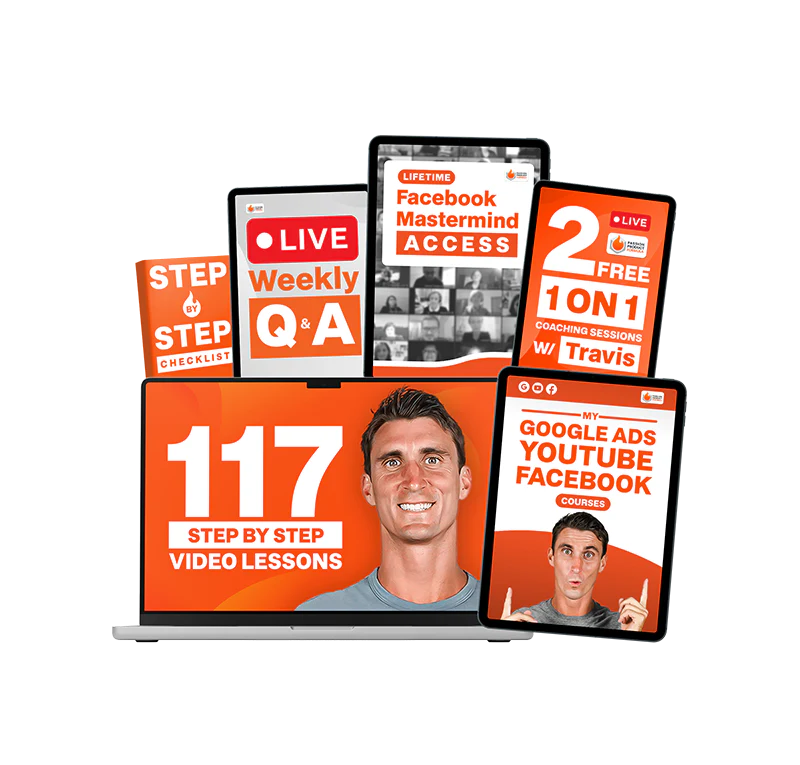
That is exactly what the Passion Product Accelerator offers. Students who join the program are 25 times more likely to successfully launch and profit from their Amazon FBA business compared to those who try to figure it out independently. The program includes direct coaching from Travis, Connor, AJ, James, and the rest of the team, access to all the templates and tools you need, and membership in a community of sellers who are going through the same journey alongside you.
The best first step you can take today is to apply for a free strategy call with the Passion Product team. On this call, you will get personalized guidance on your product idea, clarity on the process, and a clear picture of what working together would look like. Not everyone who applies will qualify, but if you made it through this entire article, you are clearly someone who takes this seriously, and that is exactly the kind of person the team loves to work with. Click the link below to apply, and start building the business and the life you have been working toward.
Frequently Asked Questions
How much money do I need to start an Amazon FBA business?
You can get started with as little as $3,000 to $5,000, which covers your initial inventory order of 500 to 1,000 units, a Helium 10 subscription, a UPC barcode, LLC formation, and a trademark application. If you do not have that amount saved, Travis and his students have successfully used Kickstarter and Indiegogo to raise their startup capital through pre-orders before manufacturing a single unit.
How long does it take to start making money on Amazon?
Most students who follow the Passion Product Formula begin generating sales within two to four months of starting their product research. The timeline depends primarily on how quickly you validate your product, place your manufacturing order, and complete your launch sequence. Travis launched Carnivore Electrolytes from idea to live listing in just seven days, though most sellers take longer to ensure everything is done properly.
Do I need to live in the United States to sell on Amazon.com?
No. Amazon allows sellers from virtually anywhere in the world to sell on the U.S. marketplace. You will need a U.S. bank account (which services like Payoneer or Mercury can help you set up internationally), and it is generally recommended to form your LLC in Wyoming if you are based outside the U.S. Travis’s course addresses international sellers directly and provides guidance on navigating the specific requirements.
What is the difference between a Passion Product and generic private label?
Generic private label means finding a commodity product on Alibaba, putting your logo on it, and competing in a crowded market primarily on price and PPC spending. A Passion Product is a differentiated product built around a specific niche or audience, something that solves a problem or serves a community in a way that existing products do not. The key difference in outcomes is that Passion Products require far less advertising spend, face much less competition, and build brand loyalty that generic products cannot.
Do I need a trademark before I can start selling on Amazon?
No, you do not need a trademark to create a listing and start selling. However, having a pending trademark application is enough to apply for Amazon Brand Registry, which unlocks A+ content, storefronts, brand ads, and IP protection tools. The trademark application costs $275 and can be filed directly on the USPTO website without a lawyer. Getting this started early is strongly recommended.
What is Amazon Brand Registry and why does it matter?
Amazon Brand Registry is a program that recognizes you as the official brand owner of your product on the platform. It gives you access to enhanced listing features like A+ content and branded storefronts, allows you to run Sponsored Brand and Sponsored Display ads, and gives you tools to report and remove counterfeit or unauthorized listings. Brand-registered sellers also receive preferential treatment from Amazon in disputes and account support.
What is the Passion Product Accelerator and how is it different from this free course?
The Passion Product Accelerator (PPA) is Travis’s paid mentorship program that takes everything in the free course and builds a full support system around it. In addition to step-by-step video training, members get direct access to coaches, personalized feedback on their product ideas and listings, a community of active Amazon sellers, proprietary templates and tools, and ongoing accountability. The free course gives you the knowledge, the Accelerator gives you the guidance, community, and execution support to actually implement it.